Longevity
Biological age: what it is and how to lower it
By Kim Ingwersen · 6 October 2026
Two people who are both 50 can have bodies that are very different in age. One may have the heart, muscles and cells of a 40-year-old, the other of a 60-year-old. Biological age tries to capture that difference. Here is what it is, how it’s measured, and what actually moves it.
What is biological age?
Chronological age is simply how many years you have lived. Biological age tries to measure how old your body is at the cellular level, and the two numbers can differ a lot. Your genes play a part, but so does how you live: exercise, sleep, stress and diet.
In biohacking, interest in measuring biological age has grown fast. It gives a more precise picture of your health than your birth year, and it lets you track whether your own changes are working.
How biological age is measured
Telomeres
Telomeres are protective caps at the ends of your DNA strands, a bit like the plastic tips on shoelaces. Every time a cell divides, they get a little shorter. Short telomeres are closely linked to ageing and age-related disease.
Epigenetic clocks
Epigenetic clocks look at DNA methylation: chemical marks on your DNA that switch genes on or off without changing the DNA itself. The pattern of these marks changes predictably with age, so it can be used to calculate a biological age. Epigenetic age often predicts future health risk better than chronological age.
Most commercial biological age tests use an epigenetic clock, usually from a saliva or blood sample.
Exercise: up to nine years younger
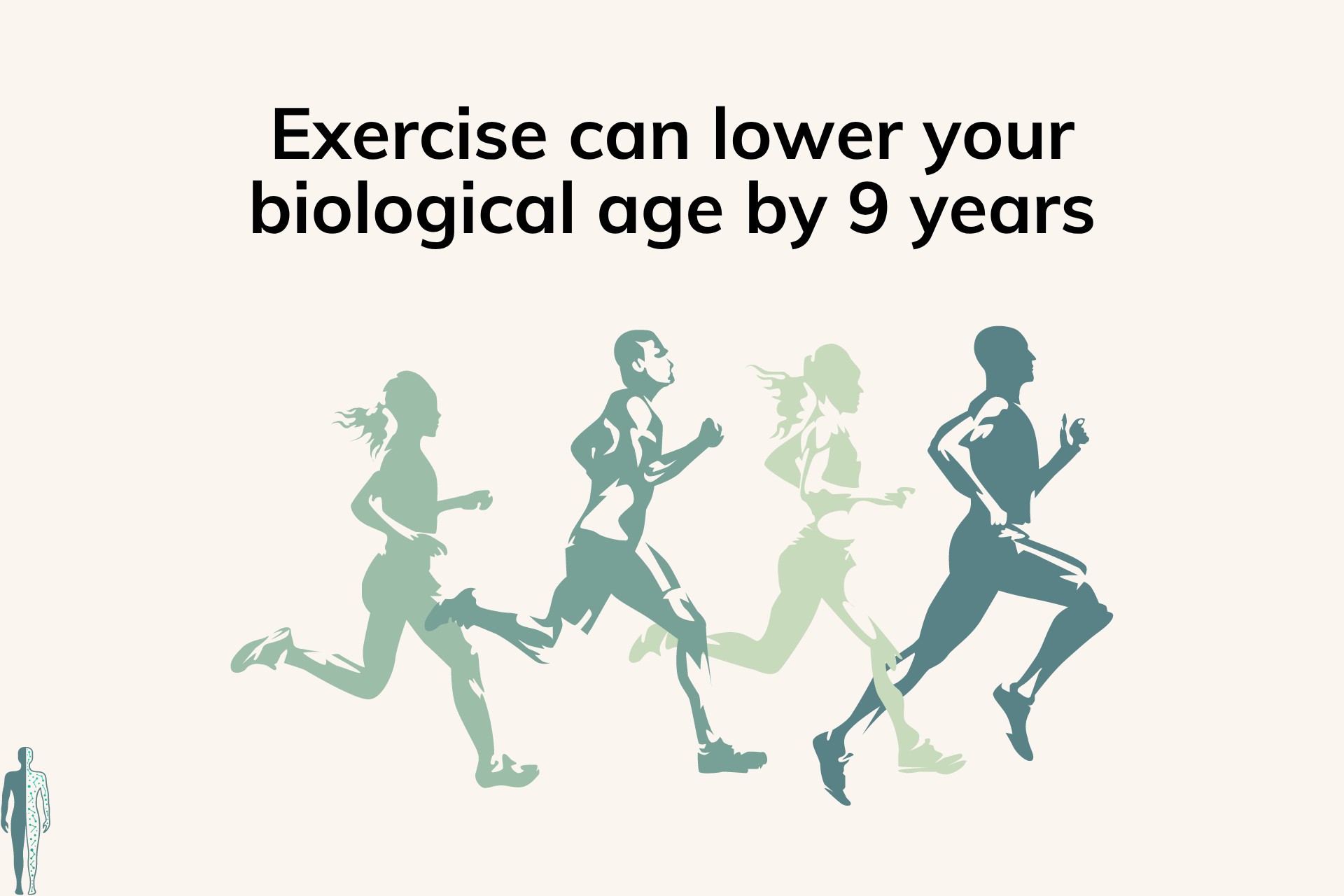
Professor Larry Tucker at Brigham Young University studied telomere length in about 6,000 American adults. People with high levels of physical activity had much longer telomeres than people who were sedentary. The difference equalled about nine years of biological ageing (Tucker, 2017).
It’s a cross-sectional study, so it shows a link, not that exercise alone explains the difference. But it fits with everything else we know about exercise and health.
How much is “highly active”?
To be classed as highly active in the study, women had to do the equivalent of at least 30 minutes of jogging five days a week, and men 40 minutes. That’s a lot more than the minimum recommendations. A bit of exercise helped less: the big difference came at the top.
Can you reverse biological age?
Epigenetic ageing seems to be partly reversible. In a small pilot study, 43 healthy men aged 50–72 followed an eight-week program with changes to diet, sleep, exercise and relaxation, plus probiotics and a plant-based supplement. Their epigenetic age was 3.23 years lower than in the control group (Fitzgerald et al., 2021).
The researchers say larger and longer studies are needed. But this kind of self-experiment is exactly what many biohackers, like Bryan Johnson, do: try something, measure, adjust.
Other things that affect biological age
Exercise has the strongest evidence, but it’s not the only factor:
- Sleep: in a study of more than 2,000 older women, those with insomnia symptoms had a higher epigenetic age than those who slept well (Carroll et al., 2017).
- Stress: more stress over a lifetime was linked to faster epigenetic ageing in a study of 392 adults. Many of the sites in the epigenetic clock respond to stress hormones (Zannas et al., 2015).
- Diet: folate and other methyl donors are used in DNA methylation and were part of the diet in the Fitzgerald study. How much diet alone affects the clock is still unclear.
Not just a lower number: more healthy years
Biological age is a measure. What you really want is more healthy years, and here the research points the same way:
- Exercise: in a pooled analysis of more than 660,000 people, those who met the recommended activity level had about 30% lower mortality than inactive people (Arem et al., 2015). Interval training also seems to boost mitochondria, including in older adults (Robinson et al., 2017).
- Sleep: both too little and too much sleep are linked to higher mortality (Cappuccio et al., 2010).
- Heat: regular sauna use is linked to a lower risk of heart disease and dementia. See sauna benefits.
- Supplements: don’t take them just to take them. Test your levels with a blood test first.
- Tracking: smartwatches and biological age tests can show whether what you do is working. That’s how many biohackers work: try, measure, adjust.
Find exercise you enjoy
The study results are clear, but they ask a lot: jogging, cycling or other hard exercise at least five days a week. The best training is the one you’ll keep doing. If you hate running, you won’t run five times a week. Find something you like, and combine it with good sleep and a balanced diet. Those are the three best-documented tools for slowing your own ageing.
Sources
- Tucker LA (2017): Physical activity and telomere length in U.S. men and women: an NHANES investigation. Preventive Medicine
- Fitzgerald KN et al. (2021): Potential reversal of epigenetic age using a diet and lifestyle intervention: a pilot randomized clinical trial. Aging
- Carroll JE et al. (2017): Epigenetic aging and immune senescence in women with insomnia symptoms. Biological Psychiatry
- Zannas AS et al. (2015): Lifetime stress accelerates epigenetic aging in an urban, African American cohort. Genome Biology
- Arem H et al. (2015): Leisure time physical activity and mortality: a detailed pooled analysis of the dose-response relationship. JAMA Internal Medicine
- Robinson MM et al. (2017): Enhanced protein translation underlies improved metabolic and physical adaptations to different exercise training modes in young and old humans. Cell Metabolism
- Cappuccio FP et al. (2010): Sleep duration and all-cause mortality: a systematic review and meta-analysis of prospective studies. Sleep
Frequently asked questions
What is the difference between biological age and chronological age?
Chronological age is the number of years you have lived. Biological age estimates how old your body is at the cellular level, and can be both lower and higher than your chronological age.
How is biological age measured?
Researchers mainly use telomere length and epigenetic clocks, which read chemical marks on your DNA. There are commercial tests too, but they vary in quality, and results from different tests are hard to compare.
Can you lower your biological age?
Studies suggest so. Very active people had longer telomeres, equal to about nine years less biological ageing, and in a small study, eight weeks of changes to diet, sleep and exercise lowered epigenetic age by about three years.
Are biological age tests worth it?
They can be useful if you take the same test before and after a change, to see if it moves. A single result says little on its own, and different tests can give quite different numbers.